Jerye
Introduction of Jerye
Jerye, known in Korean as the ancestral rite, is a traditional ritual aimed at honoring the memory of deceased ancestors and expressing respect and gratitude toward them. Deeply rooted in the Confucian principle of filial piety, this ceremony has played a central role in Korean families for centuries. It is most commonly performed during holidays such as Chuseok or Seollal, as well as on death anniversaries, helping families maintain the memory of their ancestors.
History of Jerye
The origins of Jerye trace back to ancient Confucian traditions, as described in the Liji (Book of Rites), one of the Five Confucian Classics. The text states that “the king performs rituals to honor the heavens, feudal lords to honor nature, and the gentry to honor their ancestors.” Paying homage to ancestors was a widespread practice across all social strata, from kings to common citizens, and formed the foundation of morality in East Asian societies. Jerye, as a domestic ritual, differs from the more formal, state-sponsored Jongmyo Jerye, conducted at the Jongmyo Shrine to honor the kings of the Joseon Dynasty.
Procedure of the Jerye Ceremony
The Jerye ceremony consists of a series of precise rituals that create a solemn and respectful atmosphere. Most stages involve a standard offering procedure: the master of the ceremony or a designated participant lights incense, pours wine into a cup, rotates it three times over the incense burner, and pours the wine into a bowl in three portions, concluding the stage with bows. Each stage, however, includes unique elements that give the ceremony structure and meaning. Below, the stages are described with their specific features and differences to ensure clarity and avoid repetition.
Space Preparation (Yeong-Sin)
The ceremony begins with preparing the space, symbolizing the invitation of the ancestor’s spirit. The front gate of the house is opened wide to welcome the spirit. In the room, on its northern side, a folding screen, a ceremonial table with food offerings, a mat, and a paper ancestral tablet are set up. A candle, incense burner, incense jar, small ceremonial table, and a bowl for collecting sacrificial wine are also prepared.
Commencement of the Ritual (Gyeong-Sin)
The master of the ceremony, seated before the ancestral tablet, lights incense, creating an atmosphere of focus and reverence. An assistant on the right pours wine into a cup, not filling it completely. The master rotates the cup three times over the incense burner and pours the wine into the bowl in three portions, symbolizing respect and devotion. The empty cup is returned to its place, and the master performs two deep bows, paying homage to the ancestor.
Engagement of Participants (Cham-Sin)
All participants in the ceremony perform two bows, expressing collective respect. The master then arranges meat and soup on the table, while the assistant prepares rice and side dishes, creating a harmonious arrangement of offerings.
First Offering (Cho-Heun)
The master lights incense again, and the assistant pours wine into the cup. As before, the master rotates the cup three times over the incense burner and pours the wine into the bowl in three portions. The assistant places the bowl between the rice and soup, and chopsticks are laid above the dishes. The master performs two bows. At this point, a written prayer is read by the master or another participant, who kneels before the altar, while the others prostrate themselves in a gesture of respect.
Subsequent Offerings (A-Heon and Jong-Heon)
In the A-Heon phase, a close relative repeats the Cho-Heun procedure, except for pouring the wine into the bowl, and performs four bows, distinguishing this stage from the previous one. Then, another relative, as Jong-Heon, performs a similar ritual but pours wine seven times, adding special symbolic significance to this stage.
Supplementing the Offerings (Chim-Jak)
After the Jong-Heon role is completed, the master pours wine into the cup three times, reinforcing the symbolic offering.
Arranging Utensils (Sap-Si-Jeong-Jeo)
The assistant places a spoon in the center of the rice and lays chopsticks above the fish or meat dish, a step known as Sap-Si-Jeong-Jeo. Following this, the master performs two bows, and the assistant performs four, emphasizing their roles in the ceremony.
Break (Hap-Mun and Gye-Mun)
Participants retreat briefly to the main room or garden, allowing a moment of reflection. The assistant clears their throat three times, signaling the return to the ritual.
Conclusion of Offerings (Heon-Da and Cheol-Si-Bok-Ban)
The soup is removed from the table and replaced with drinking water. The master scoops three spoonfuls of rice and places them in the water, symbolizing the end of the offering phase. Then, the spoons and chopsticks are returned to their original places, and the bowls are covered with lids.
Farewell to the Spirit (Sa-Sin)
One participant performs two bows, then burns the paper ancestral tablet and the written prayer. The assistant returns the tablet to its original place, symbolizing the farewell to the spirit.
Clearing the Table (Cheol-Sang)
All food items are removed from the table, starting from the back, in an orderly manner.
Communal Consumption (Eum-Bok)
At the conclusion, participants consume a small amount of the food and wine from the altar, treating them as blessed by the ancestors. The food is also shared with relatives and neighbors, strengthening social bonds and a sense of community.
Contemporary Practice
Today, Jerye often takes a simplified form, especially in urban settings. Families may limit the ceremony to setting up a table with basic offerings like rice, soup, and fruits, lighting incense, and performing a few bows. Stages such as A-Heon or Jong-Heon are often omitted, and the number of dishes is reduced. In some households, photographs of the deceased replace paper ancestral tablets. Simplified Jerye is popular during Chuseok, Seollal, and death anniversaries, allowing the tradition to adapt to modern lifestyles while preserving its essence.
Atmosphere of the Ceremony
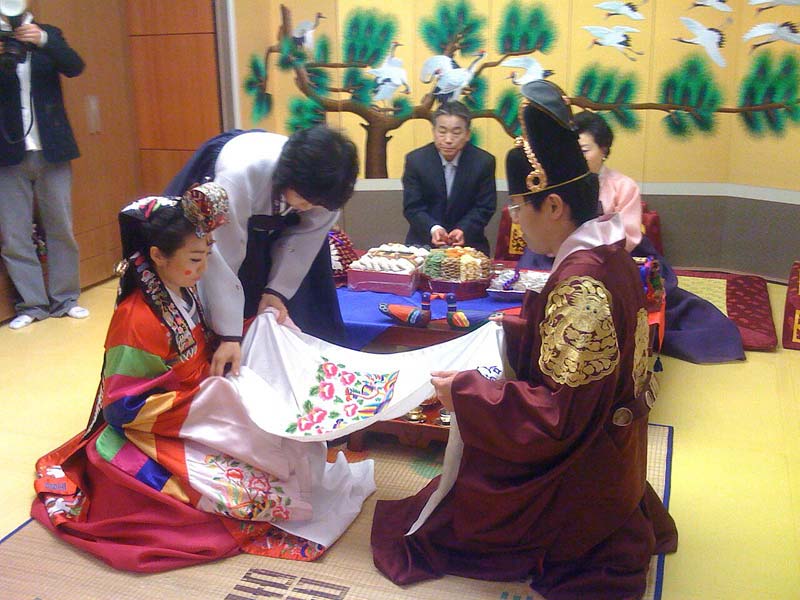
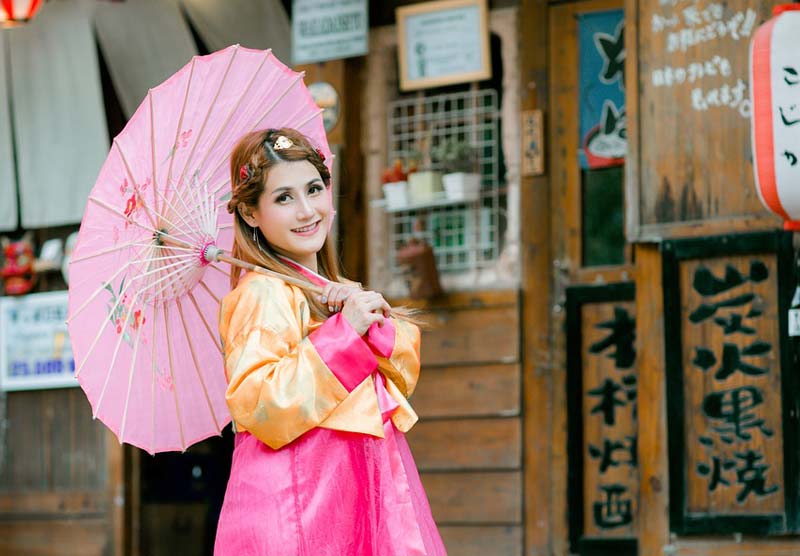
Jerye takes place in a calm, respectful atmosphere. Participants, often dressed in traditional hanbok or formal attire, gather around the ceremonial table. The scent of incense and the sight of carefully arranged offerings create a reflective mood. Moments of silence, interspersed with rhythmic bows and the reading of the prayer, allow the family to focus on the memory of their ancestors.
Jerye vs. Jongmyo Jerye
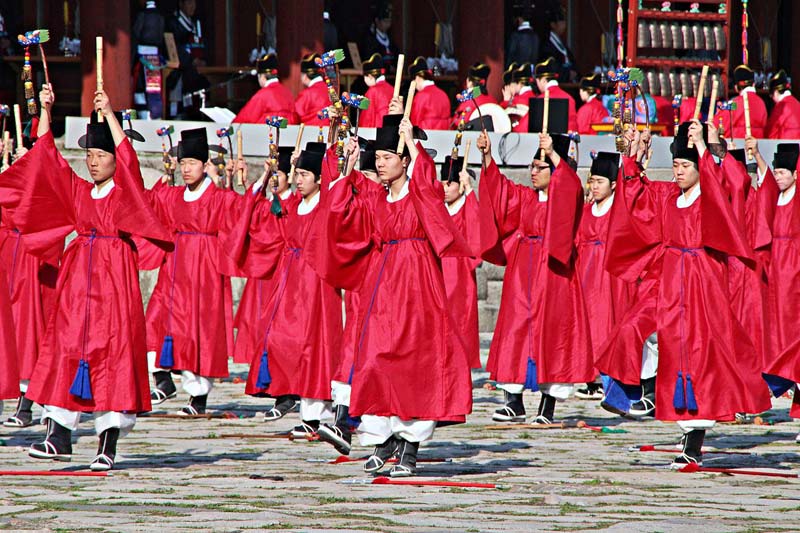
Jerye is the general term for domestic ancestral rituals practiced by families in homes or at gravesites. In contrast, Jongmyo Jerye is a more formal, state-sponsored ceremony conducted at the Jongmyo Shrine in Seoul to honor the kings of the Joseon Dynasty. Jongmyo Jerye includes traditional music and dance, has a national character, and is listed as a UNESCO World Heritage event. Both ceremonies share the Confucian principle of honoring ancestors but differ in scale, context, and formality.